



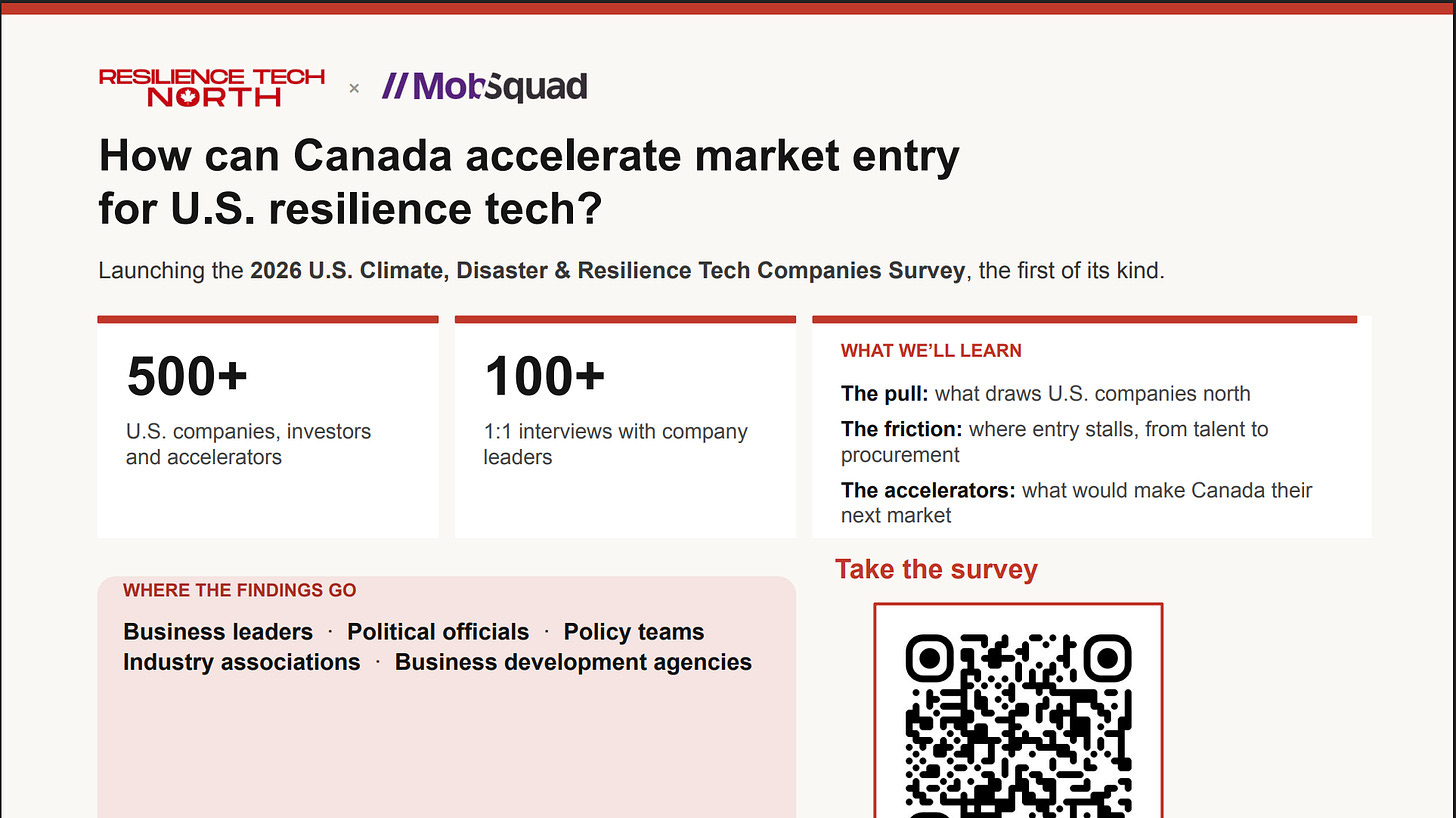
Across two packed Toronto days, the 2026 Canada Safety & Security Trade Mission moved from cross-border ambitions to funding, procurement, and deployment. Day Two—the first Toronto day—opened with a delegate Q&A and the launch of the 2026 U.S. Climate, Disaster & Resilience Tech Companies Survey by Resilience Tech North (RTN) and MobSquad. Its question: what would help U.S. companies pilot, test, and expand in Canada?
GO-Biz, the California Governor’s Office of Business and Economic Development, convened the delegation with support from Channel Architect.
“When a state like California and a country like Canada connect their companies directly, deals move faster, and partnerships last longer.”
— Channel Architect
“We are starting by focusing on what U.S. companies in this sector would need to accelerate their Canadian expansion and growth.”
— Resilience Tech North
“Access to expertise and talent is often a key deciding factor in where a company grows.”
— MobSquad
Shared risks, cross-border opportunity
Wildfires, floods, and grid disruptions do not stop at the border. The survey connects those shared risks with Canadian investment in resilience infrastructure, energy, emergency preparedness, and technologies with civilian and national security applications. The challenge is turning opportunity into deployment—and identifying what companies need to make that happen.
What would bring companies north?
RTN and MobSquad plan to reach over 500 U.S.-based companies and interview more than 100 company leaders across climate, energy, security, emergency response, and risk technology. Findings from the independent research are expected in early 2027, showing where companies see openings and what barriers remain.
Explore the collaborators: RTN | MobSquad | GO-Biz | Channel Architect
At MaRS Discovery District, from Introductions to Next Steps
Toronto’s second day brought a full schedule of site visits and dialogue.
Funding: Finding the Canadian Fit
Opal AI raised US federal government agency support, prompting discussion of Innovation Canada as a funding and business-services starting point for companies targeting insurers and utilities. Program fit and eligibility remained to be assessed.
Red Line Safety’s firefighter wearable and app prompted suggestions to seek feedback or endorsement from public safety employee unions, the Workplace Safety and Insurance Board, and public health agencies. Frontline validation matters alongside finding buyers.
MAKESafe Tools’ industrial-safety focus helped frame an exchange on Canadian funding, validation, and industry partnerships.
Partnerships: Connecting technology with industry
Safety Engineering International’s rollover protection system led to two potential industry contacts: armored-vehicle manufacturers and automotive supplier channels.
The visit made the follow-up agenda concrete: funding to investigate, feedback to seek, and partners to approach.
Shifting from Market Entry to Los Angeles 2028 Olympic Summer Games Prospects
The conversation then turned closer to home, courtesy of a well-attended lunch hosted by the American Chamber of Commerce-Toronto and Fasken: Los Angeles 2028 Summer Olympic Games contracts. At an October 21 lunch briefing, a guest speaker from City of Toronto Police shared FIFA World Cup planning lessons. For California delegates, the message was practical: promising technology needs a credible plan to deploy, integrate, and support it.
Start early—and understand the buyer
Four years of preparation included learning from international events and coordinating with agencies and local organizations. Budget limits and long implementation timelines restricted late adoption of unfamiliar technology. Prospective suppliers need to demonstrate readiness early, with a clear use case, deployment schedule, and training and support plan.
Discussion of municipal and federal procurement reinforced the need to identify the actual buyer and bidding process. Games-related opportunities are not a single procurement channel, and organizing committee supplier registration does not guarantee an opportunity.
Show how the solution fits the operation
Training across 45 agencies, a unified command centre, and uninterrupted everyday emergency services illustrated the coordination required. An adapted incident-management system showed the value of supporting existing workflows. Bidders need to explain how their products help teams work together without adding complexity.
Build flexibility into the proposal
The speaker emphasized flexibility, alternative plans, and a shared playbook. Suppliers can reflect those lessons through adaptable delivery, evidence, implementation plans, and dependable support. Delegates also expressed interest in the forthcoming post-event briefing.
The briefing offered no shortcut to an Olympic contract—only a sharper view of what makes a credible contender.
Procurement Readiness for Wildfire Resilience Partnerships
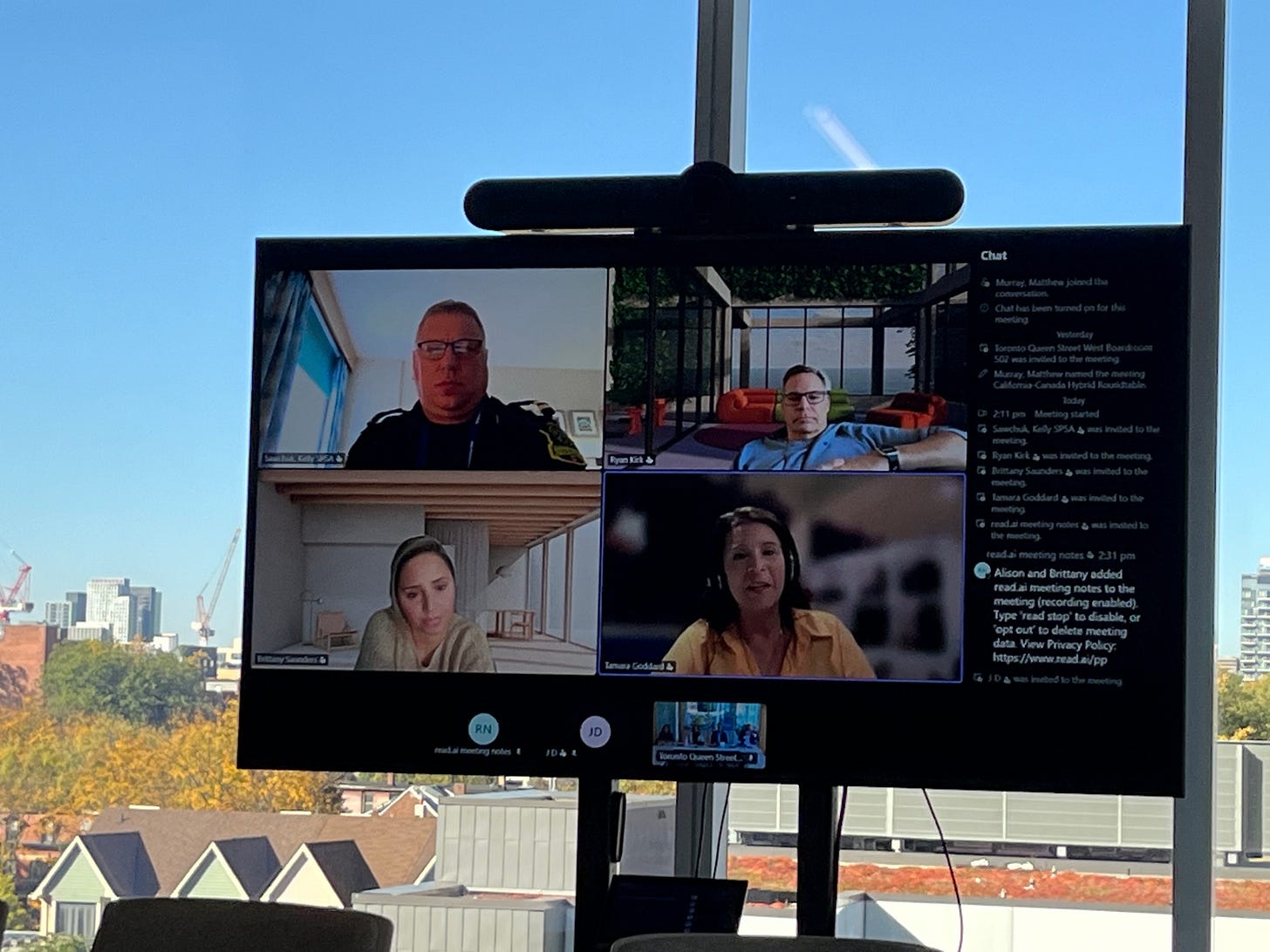
The final session returned to a shared California–Canada challenge: wildfire resilience. At Northeastern University’s Toronto stunning new campus, a hybrid exchange connected delegates with provincial, First Nations, and industry leadership to explore the relationships, evidence, and funding needed for workable pilots.
Market entry: Start with regional needs
A Saskatchewan Public Safety Agency representative connected fire response, forestry, emergency operations, and Indigenous emergency services. Provincial silos underscored the need to understand local priorities and procurement rather than treat Canada as one buyer. Wildfire conferences and municipal associations offered routes to regional connections.
Partnerships: Build around community priorities
First Nations leadership in defining needs anchored discussion of cultural fire stewardship, preparedness, and service-provider collaboration. The First Nations’ Emergency Services Society of British Columbia was identified as a resource. Prospective partners were encouraged to listen before assuming a technology fits.
Data: Establish the ground rules early
Data sovereignty raised practical questions about control, sharing, and analysis. Environmental, fuel, soil, and moisture data featured alongside anonymization and emerging wildfire modelling. Data governance, the discussion reinforced, belongs at the outset of a partnership.
Funding: Shape the pilot before seeking support
Pilot-budget questions led to community-led funding, federal procurement, and established delivery partners. Canada’s minimum 5% federal Indigenous procurement target applies to eligible Indigenous businesses, not automatically to visiting suppliers. Scientific Research and Experimental Development (SR&ED) incentives were another avenue to assess. No pilot budget or funding commitment was confirmed.
The Toronto meetings brought cross-border opportunity into focus. For wildfire companies, the next step is a pilot shaped with First Nations leadership and other partners, grounded in community needs, agreed data responsibilities, and a credible funding route.
Two full Toronto days turned introductions into sharper questions about pilots, procurement, and market entry. The delegation heads west to explore where the next partnerships might take shape. Two down, one to go. Up next: Calgary!